My first hackathon
What I made and how was my experience
This past weekend I went to my first hackathon, HackDecouverte, which is part of ConUHacks at Concordia. The prompt was pretty broad: build an app that helps students. My team, Nova, built Orbit, a campus companion app for Concordia. My job was building the indoor navigation system and giving directions across different floors of the Molson Building.
Spoiler: we didn't place. I'll get into why at the end, mostly because it's the most useful thing I learned this weekend.
My team at the Hackathon
I registered solo. Once you're registered you get invited to the event's comms server, where the organizers post announcements and updates about the event. That's also where people without a team look for one and that's where I found mine. There were 4 of us and I had never met any of them before. The first time we saw each other in person was the morning of the event.
Honestly, I was expecting it to be awkward. It wasn't. We had good synergy pretty much right away and the collaboration was smooth for the whole event.
Noam (my teammate) took the lead. Within the first few hours he had set a clear direction for the project and started organizing the work. He split up the tasks, kept everyone moving toward the same goal and made sure the pieces actually fit together at the end. He also knew the tools we were using really well, which made the whole team move faster. He handled the pitch to the judges too, which is not easy (5 minutes to present a full app with a lot of features) and he covered every detail without losing clarity.
Facundo (my teammate) was cracked at SWE. He was basically the one guiding development. He set up the framework, the rules and pretty much everything relating to how the systems fit together and he did a big chunk of the work himself. Sadly, he had to leave 3 hours before submission, but by then he had left us a solid foundation to finish on.
Picking an idea
When it came time to plan, everyone came with their own idea.
Mine was indoor navigation. I have already built road-based pathfinding for Taxi Boss, so I wanted to try the same ideas on a real building. Every floor at Concordia has its floor plan posted near the elevators, so we could map everything out, build a navigation mesh and make a quick Google Maps style view of the building, in 2D from a bird's eye view.
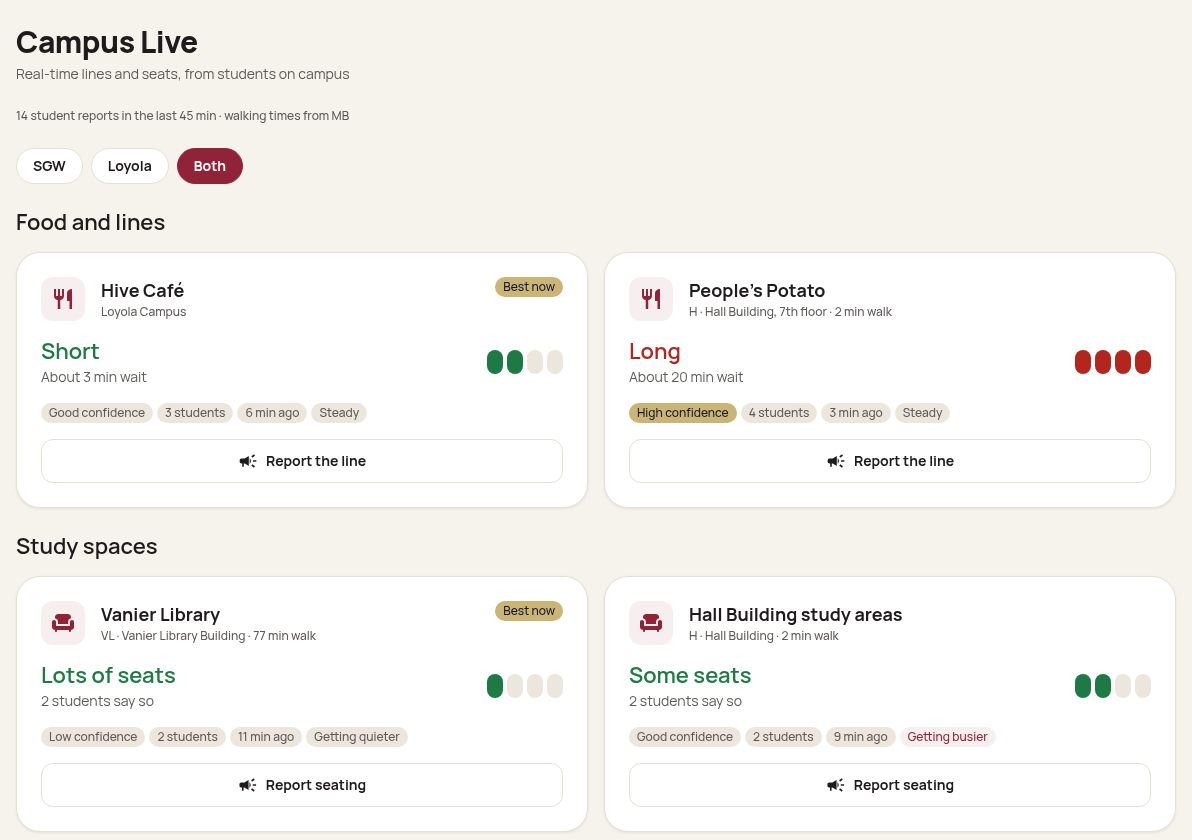
Noam's idea came from something every student deals with. During breaks or when you don't have class, you go grab food and end up waiting in a long line or you walk into a crowded spot and waste your time and maybe don't even get your food in the end. He wanted students to be able to report how long a line is or how packed a place is, so the next person knows before they walk over. On top of that, the system estimates how long the wait is and predicts when during the week a place gets busy, based on previous reports.
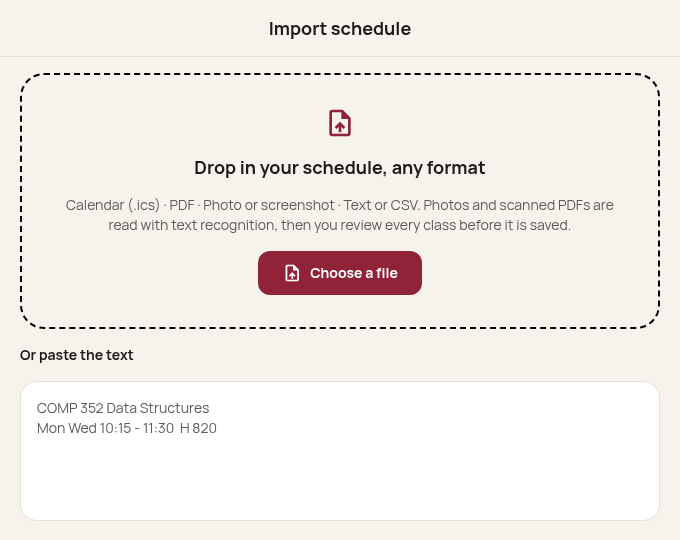
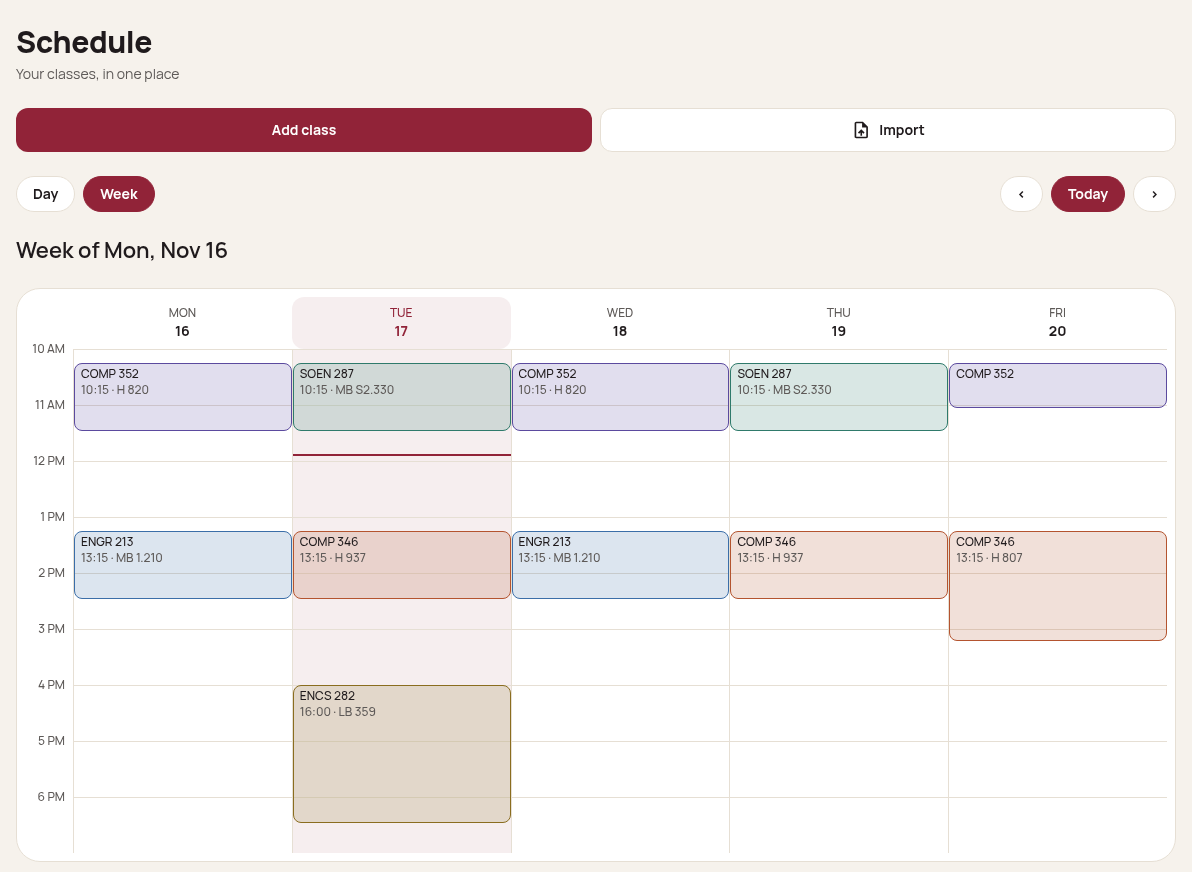
Facundo's idea was about schedules. You upload your schedule as a PDF or a screenshot, it gets parsed and the app now knows your timetable. It can notify you when it's time to go to class, tell you which way to go and help you manage your time between classes.
We didn't pick one idea. We put all of them in. It felt like the obvious call at the time, and it's a big part of why we didn't place.
What we built
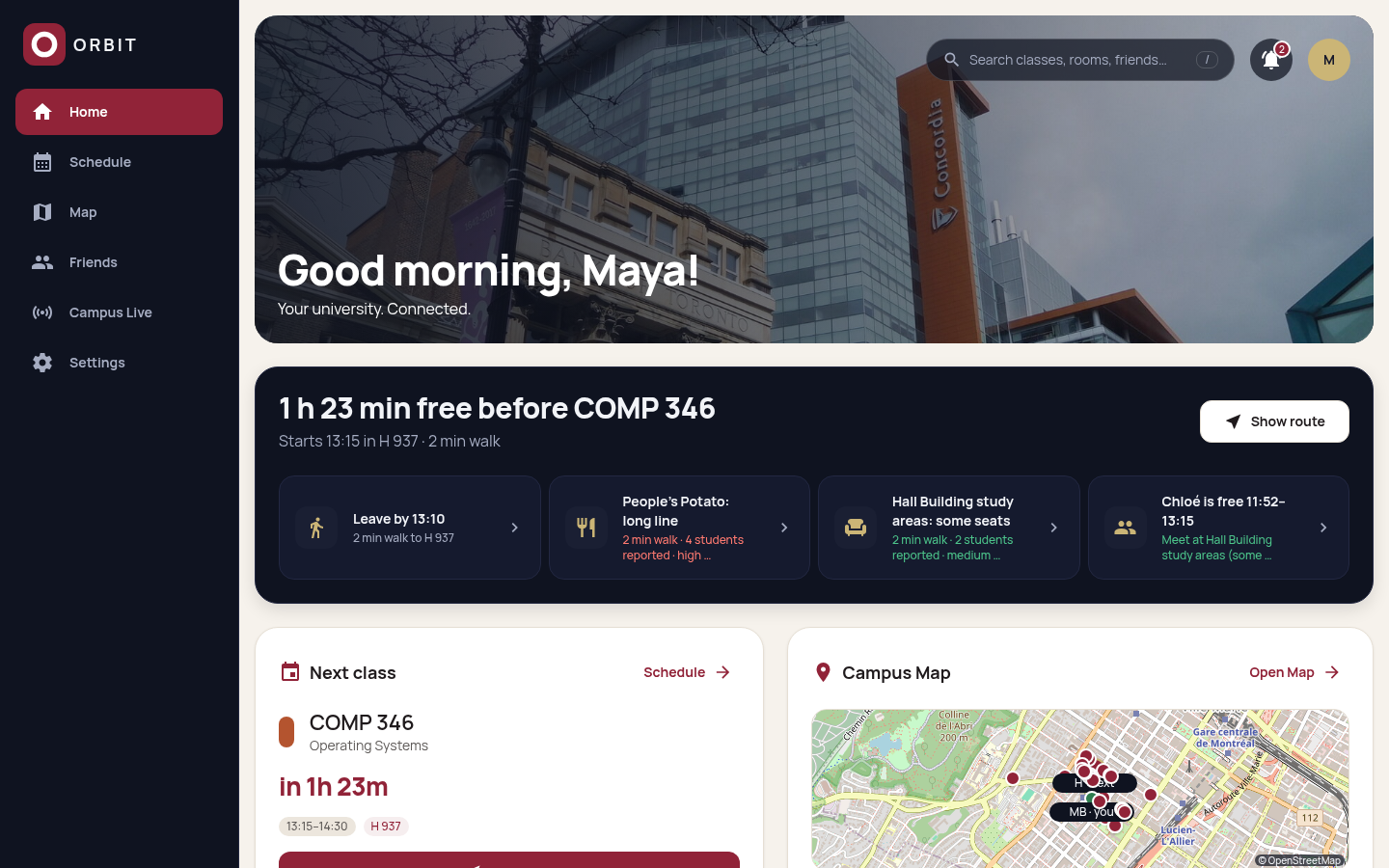
The home screen became a dashboard that combines everything into one plan for right now: how long you're free, when to leave for your next class, the shortest food line and emptiest study spot that fit in your window and which friends are free at the same time.
Noam's idea became Campus Live:
Facundo's became the schedule import and the week view:
On the side, we added friends, so you can see which of your friends are free and which are in class. That makes it easy to coordinate study sessions or plans. We also added Microsoft login, so Concordia students can sign in with their school account.
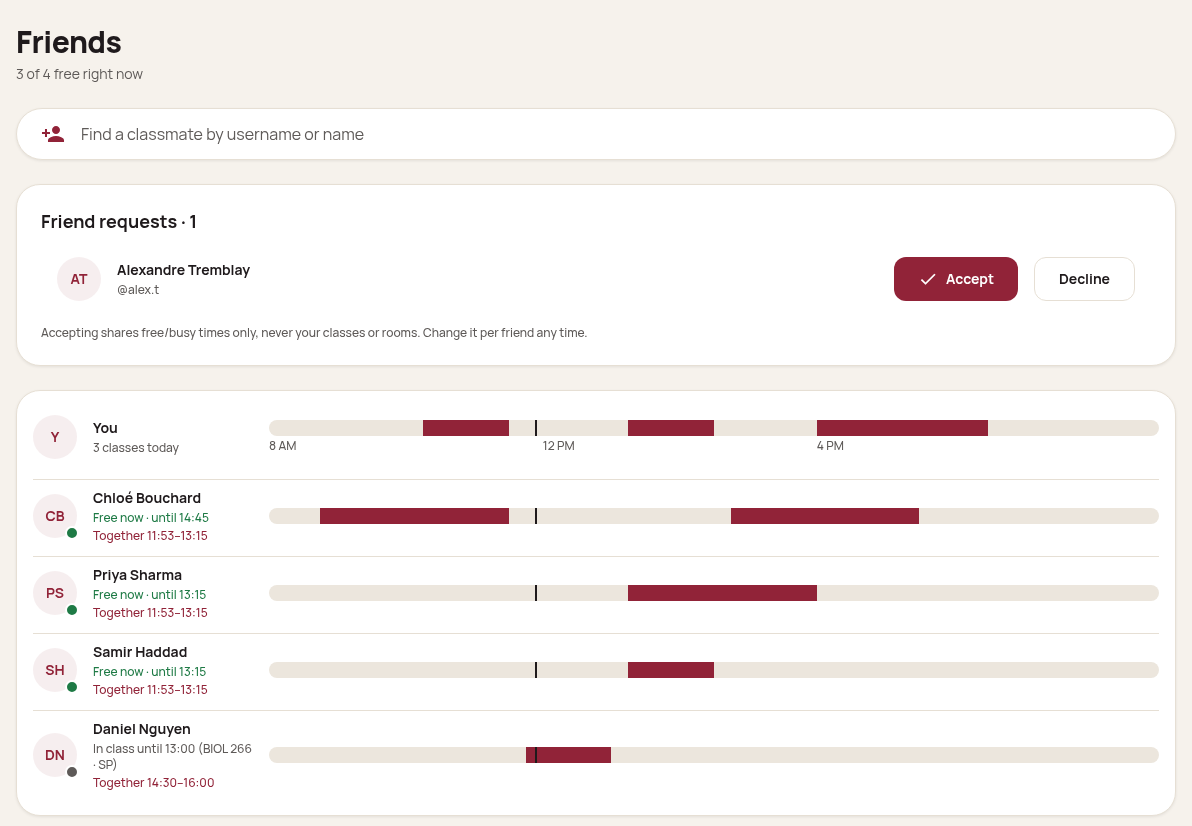
It was built with Expo (so web, iOS and Android from one codebase), TypeScript and Supabase.
The navigation
My idea became the navigation and since it was my main focus, here is how I actually put it together.
Turning floor plans into a navmesh
The plan was to trace the floor plans posted by the elevators. I ended up not needing to: Concordia's open data already has floor plans for the Molson Building. I turned those into a navmesh where every node is a spot you can stand at and every link is a walkable path between two of them.
I broke the nodes down into 5 types:
- Rooms, one node per room (
MB-1.130, etc.). - Doors, linking a room to the hallway.
- Hallway waypoints, the points the corridors are made of.
- Stairs and elevators, linking floors together.
- The building entrance, which is the default starting point.
Every room connects to its door, every door connects to a hallway waypoint and the hallways connect to each other and to the stairs and elevators. Once that graph is built, getting from MB-1.130 to MB-3.210 just becomes a standard shortest-path problem.
I did hit one early issue. The raw navmesh data lists most hallways as one-way. If you load the graph straight from the data, half the building becomes inaccessible. Fixing it just meant registering every link in both directions:
add(l.fromId, l.toId, link);
add(l.toId, l.fromId, link);
Pathfinding
For the actual routing, I used A*, the same algorithm I used in Taxi Boss. The difference is that road networks are way more forgiving than buildings. Roads are basically already flat graphs, whereas changing floors in a building isn't "free."
Taking the stairs or the elevator eats up time that doesn't show up as physical distance on a 2D map. To account for that, I added an extra penalty onto vertical links on top of their actual length:
const VERTICAL_COST: Record<string, number> = { elevator: 25, stair: 35 };
Without that penalty, the algorithm would happily route you up a flight of stairs and right back down just to shave a few pixels off a hallway walk. A fixed cost per connector type is the simple version of this.
For the heuristic, I used straight line distance to the goal. The thing with A* is that your heuristic can never overestimate the true remaining cost or it stops guaranteeing the shortest path (Amit Patel's notes on A* heuristics are the best explanation of this I know of). If any link in the dataset happened to have a weight smaller than its raw Euclidean length, straight distance would overestimate. To keep it safe, I scaled the heuristic down using the smallest weight to length ratio in the entire graph:
if (euclid > 0) hScale = Math.min(hScale, link.weight / euclid);
const h = (id: string) => {
  const n = graph.nodes.get(id)!;
  return Math.hypot(n.x - goal.x, n.y - goal.y) * graph.hScale;
};
Floors didn't need any special math in the heuristic since vertical costs only ever add to the real cost, so the heuristic naturally stays safely underneath it. The tradeoff is the one Patel describes: the lower the heuristic, the more nodes A* expands. On a single building that's nothing.
Step-free mode
There's a step-free toggle for anyone who can't take the stairs. When it's on, A* skips every stair link and every link marked as not accessible, so the route goes through the elevator instead:
if (accessibleOnly && (!link.accessible || link.type === 'stair')) continue;
That's the whole feature. Since it's just a filter on which links A* is allowed to use, it stays the shortest path among the routes that are actually possible for you.
Turn-by-turn directions
Drawing a line on a screen is great, but when you're actually walking around lost, you want to read "turn left near MB-1.134." To generate those steps, I walked through the final path 3 nodes at a time, comparing the incoming angle to the outgoing angle.
const h1 = Math.atan2(b.y - a.y, b.x - a.x);
const h2 = Math.atan2(c.y - b.y, c.x - b.x);
let diff = ((h2 - h1) * 180) / Math.PI;
diff = ((diff + 540) % 360) - 180;
The last line wraps the angle into -180 to 180, so a small left turn doesn't come out as a 350° right turn. A few rules keep it from becoming noise:
- Only hallway waypoints can be turns, not doors or rooms.
- The turn has to be at least 40°. Hallways in the data wobble a bit and nobody wants "turn slightly left" every few meters.
- Very short segments are ignored.
- The floor plan's y axis points down, so a positive angle is a right turn, not a left one. This one got me for a bit.
Each turn grabs the closest room on that floor to use as a landmark, turning a generic "Turn right" into "Turn right near MB-1.134." Whenever the route switches floors, it calls out the direction and method, like "Take the stairs up to floor 3." Finally, I merged identical steps so zigzagging hallways wouldn't repeat the same instruction twice in a row.
Because the routing runs entirely client-side, changing your starting point updates the distance, time and directions instantly. The routing engine itself is pure TypeScript, so I could unit-test all of it independently without the app.
Why we didn't place
Ngl, I kinda expected it. Two things worked against us: the idea wasn't original and we built too much of it.
Everyone built the same thing
During the event I was socializing with other teams and asking what they were building. Almost everyone was building some version of the same thing as us. An all in one tool for students or a GPS/maps system for the buildings across Concordia's campuses. When half the room has the same idea, it doesn't matter how well you build it. The judges have already seen it like 5 times that day.
I'm not the first person to notice this. Deveesh Shetty's The State of College Hackathons puts it bluntly: "Judges are too bored seeing the same thing, have something novel so it makes them curious and interested." Kevan Gilbert's write-up of judging an ElevenLabs hackathon has a team that didn't win with a good idea, because features like theirs were already shipping in common tools. Useful isn't enough if the judges' reaction is "this already exists."
The winning project was hey jenna (GitHub). You give it a moodboard and a floor plan and it finds real furniture you can buy in the same style and colours, then places it in your room following interior design rules. You can move or swap pieces after. Nobody else was doing anything close to that. It stood out, it was creative and it was easy to understand in a 5 minute pitch. I think that's why it won.
We built everything
Our second problem was scope. We spread our time over a lot of features: schedules, friends, Campus Live, navigation, the dashboard, login. Every one of them works, but none of them is the one thing a judge remembers. One standout feature, built deeply, would probably have done more for us than 5 good ones.
The root of it goes back to the first planning session. Each of us had pitched one idea and all of them made it in and we were pretty attached to them from then on. That's nice for the team, but it's not how you win.
This is apparently the most common way to lose. JetBrains' notes from the judging table say teams often try to build five features and ship none of them cleanly and that one clear moment in a demo beats a tour of every feature. Eugene Yan's A Hackathon Where the Dinkiest Idea Won describes judges who "felt that one focused feature tweak could do more than five ambitious, though less feasible, new features." Five features is almost exactly what we had and with 5 minutes to pitch, Noam had to give a tour.
Next time
- Plan for creativity first. Before committing, ask "how many other teams are going to build this?" If the answer is "a lot", it's the wrong idea, no matter how useful it is.
- Be willing to scrap ideas, even ones you're already attached to. Mine included.
- Pick one feature on day one and go deep on it, so the pitch is one clear moment instead of a tour.
Even without placing, I'm happy with how it went. I met people I'd gladly work with again and I got to take the pathfinding from a Roblox driving game and use it on a real building. Thanks to the ConUHacks team for organizing.